I recently came across a video in internet town of A New York man conducting a cheese melting experiment. He had a leftover cheese sandwich from his children's lunch and he attempted to do a little experiment with the cheese. he placed the flame from a lighter on the cheese and the cheese did not melt at all. the color became darkened and black as you will see in the video below. for some reason, this was really interesting to me, knowing that American cheese is processed but not actually ever seeing how the processed properties take to a natural earth element such as fire.
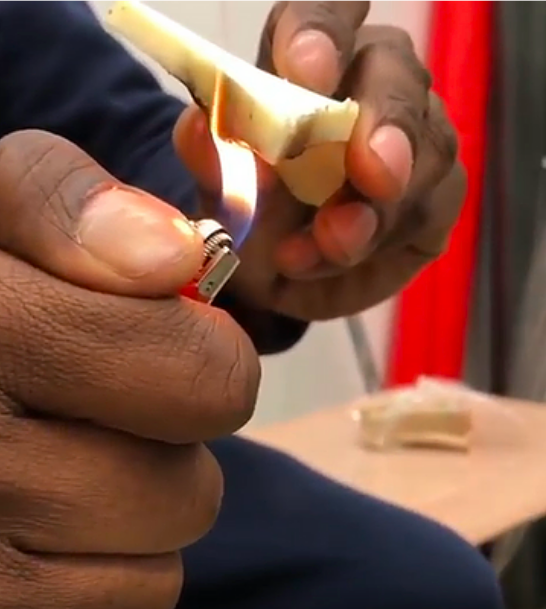
Is chemistry the reason why the cheese is not melting?
Some may argue that the cheese isn't melting because it isn't being heated on an even surface where sustained heat is applied to the entire cheese in an even manner. the flame, applied directly, is a cool flame therefore making the cheese resistant to it. The lighter fluid is made up of butane which is not a good source of fuel because it doesn't burn completely during combustion. Supposedly, the darkness forming on the cheese is carbon which is an end result of combustion when butane from the cool flame burns.
THAT'S JUST A LOAD OF SCIENCE BULL: THE CHEESE CLEARLY IS NOT NATURAL
Now one could take the opposing side and say that the science behind the non-melting cheese doesn't add up! American cheese or government cheese is filled with preservatives and emulsifiers. The emulsifier is what helps particles in processed cheese bind together. Processed cheese isn't just natural cheese; it is made from a blend of varying ingredients such as byproducts, calcium phosphate, food coloring, whey, milk protein concentrate, sodium citrate, lactic acid, and etc. The cheese is so processed that it's resistant to flame. What's even worse is that American pasteurized cheese manufacturers are only required to have at minimum 51% of real cheese in their cheese product.
Processed cheese is not natural and children should not be consuming this "food" in their lunches. Whether or not the non-melting factor of the cheese is due to cool flame, processed cheese should not be consumed. At this point, why do people even still call it food?
If you must have cheese, stick to the organic, unprocessed and rbGH free cheeses. Generally, cheese is not the most healthy food due to its high fat content. Dairy cheeses that could be considered more healthier due to lower fat content are mozzarella, feta, cottage and chèvre. Stay tuned for a future post on the best vegan (non dairy) cheeses.

.jpeg)


Comments
Post a Comment